George Silver- English backsword part 1 - The fights
This is an interpretation of George Silver's “Brief instructions” work, incorporating aspects of his “paradoxes” work.
The sword
A single or double-edged one-handed sword, with a decent hand guard providing protection from cuts from most angles. This is basically a basket hilt, but not quite as protective as a later Scottish basket hilted broadsword.
Perfect length is basically a blade from just above your hip to your outstretched off-hand, somewhere between 33 and 37 inches for me, so that you can easily stab someone with your offhand placed on their chest (or if you have a dagger, the sword tip reaches the dagger hand but no further).

The guards
Silver is quite unique in that he doesn't organise his fencing style around guards per se, but rather types of ‘fight’, with each type of fight being characteristic of one or more guards or wards.
The key guards used are:
Open (something like Guardia Alta in the Bolognese systems)
True Guardant (a high hanging guard)
Bastard Guardant (a low hanging guard)
Forehand ward (not well described but presumably the equivalent of carte or tierce in sabre, or a half cut in the Bolognese systems)
“Variable” - anything else, but usually all the various point forward guards used in rapier and Bolognese sidesword which Silver calls Stocatta, Imbrocatta, Mountanta and Passata.
The fights
Open fight
The open fight is to hold your sword straight up above the head with blade up or pointing back (which silver prefers), in an upright stance, from which you make various cuts and thrusts. I believe the sword arm should probably be fairly straight, but Silver isn't clear on this or on exactly where the hilt is held or how far forwards. It probably doesn't matter too much, so long as you are not getting your arm attacked by your opponent. You will need to decide for yourself.

Silver doesn't really describe particular cuts other than the ‘downright blow’, presumably a cut from above. Logically, from open fight cuts from above are easiest, but cuts from below or through the middle are also possible. It is unknown if the left or right leg is forwards, however left leg forwards naturally brings your sword arm a little further back out of range of the opponent.
Guardant fight
Guardant fight is to hold your sword in a high (true Guardant) or low (bastard Guardant) hanging guard. The exact nature of true Guardant is not illustrated and its description is open to interpretation:
The hilt is held above the head (but it is not clear if that means higher than the head or directly above the head itself, nor how far forwards if at all).
The blade is pointing in the direction of the left knee (but it is not clear whether that means it is literally pointing at the knee or just somewhere down and left).
The blade is not bearing out towards the opponent but held somewhat close to the body, inclined towards the left knee. Again, it is not clear how forward the blade has to be before it is considered to be ‘bearing out’ nor whether inclined towards the knee means relative to being pointed straight ahead or relative to hanging straight down.
The body is not leaning forwards but is held upright, otherwise it is ‘imperfect’.
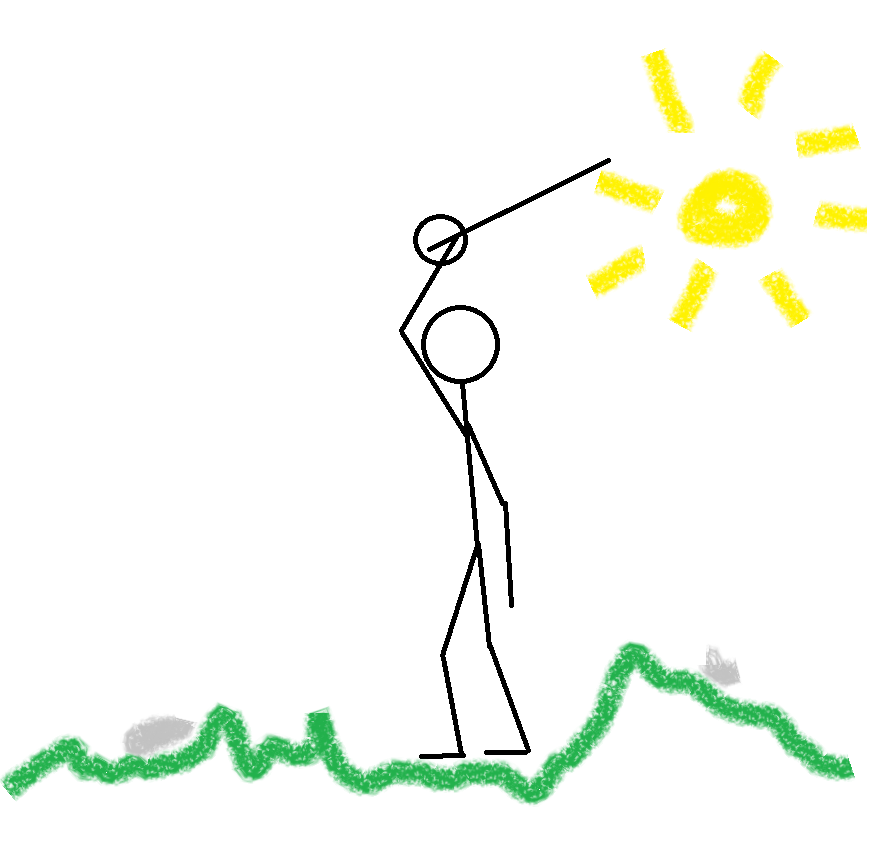
I am convinced that the sword arm should be held fairly straight as an excessive bend at the elbow will make the sword arm more vulnerable to attack. If the sword arm is held fairly straight, the hilt cannot be directly above the head (or at least that's not how my shoulder wants to work), so it must be about 6-12 inches forwards of the head with arm at about a 45 degree angle upwards. The hilt is about in line with the right ear. The blade hangs down at about a 45 degree angle. Something like this?


Now, I'm sure many people will criticise this interpretation as it is commonly believed that Silver wants us to put our hand, head and body at the same distance to the opponent (which I cover in a future post), and the blade could be angled more towards the body. So here are other interpretations:


The bastard Guardant is held lower, with hilt at around chest height and is equivalent to low prime and low seconde in foil depending on which side of the body it is used.

Variable fight
Variable fight is to use all other manner of guards, so basically prime, seconde, terza and quarta from rapier systems, or the equivalent of ox and plow in German longsword. Geroge Silver calls these by the names of the thrusts they deliver:
Stocatta: right leg forward, hilt beside your right thigh with point towards your enemy (with dagger, keep your dagger out, point up, tip of your dagger near but behind your hand. Or dagger hand held out (as above) with rapier low and outside.
Imbrocatta - your hilt above your head, knuckles up and point towards your enemy's face or breast.
Mountanta - your pommel in the palm counterbalanced by your little finger and your hand below, point at your enemy's face or beast, as with imbrocata.
Passatta - As Stocatta, but left foot forward and hilt slightly higher. With dagger, point forward with tips close.
Forehand ward is also associated with the variable fight, which is basically a parry with the hilt low and point high, i.e. carte or tierce in sabre systems, or half-cuts in the Bolognese system.

Close fight
Close fight is where the swords are crossed at their halfway point, leading to grappling.

Comments