Practical Destreza (Spanish rapier) - Part 1: Introduction, guards and attacks
Introduction
This is a practical guide to Destreza, the Spanish art of fencing. There are a lot of articles online about the history of Destreza so I won't go into any detail here, other than to say that the La Verdadera Destreza (the true skill) dates back to around 1569 with two primary authors Jerónimo Sánchez de Carranza and his student Luis Pacheco de Narváez. There were several other authors over the next 150-200 years. I am primarily working from the work of Francisco Lórenz de Rada, one of the later authors, published in the early 1700s.
Destreza is famed for its circular footwork, its upright, right-angled stance, and its scientific approach to fencing, where its authors prided themselves on their ability to 'prove' the system using geometry.
At the time of writing, I am not an expert on Destreza, simply an enthusiast who is trying to learn the system as best as he can. I am a practical person, and I am not a purist. I will use mostly English terms, and will simplify concepts as I see fit. While I am primarily working from Rada, I am just as much learning from others. Here are my main sources:
Francisco Lórenz de Rada, Nobleza de la Espada, Book Three, English Translation - Resources
Video series: Rada Explained, UmeHFS (YouTube) - part one here: Rada Explained 1: The Introduction video - YouTube
Video series: Puck and Mary Curtis - Derstreza (YouTube) - part one here: Destreza 01 - Puck & Mary Curtis
Video: La Verdadera Destreza: Spanish Rapier Volume I & II (Anthony De Longis and Palpable Hit Productions, Martinez Academy of Arms): The Swordsman’s Shop
The weapon
I am using a cup hilt rapier. Some of my friends are using swept hilt rapiers. Length is typically 41 inches. Historically, the weapon length was limited by law to around 41 inches, and the ideal length of the blade was typically thought to be where the cross was level with the navel when the tip was pointing directly down and resting on the floor. Cup hilt rapiers would have been common from 1630, but before that they would have been using swept hilts or something in between. This is important because, while cup hilts are much more defensive against thrusts to the hand, swept hilts can be used, and you need to be extremely aware that the opponent can thrust at your hand if you do not actively defend against this.
Like all rapiers, we have a tip, a true edge, a false edge, a hilt, quillons, a grip and a pommel.
The rapier is split into 4 equal lengths, with 1 being at the tip and 4 being at the hilt. This is useful for the binds that will be described later in this series, where you can place the 3rd of your blade on the 2nd of theirs, gaining leverage since the 3rd is closer to the 'strong' of the blade. The higher the number difference, the stronger the bind you have, i.e. 4-1 is the strongest bind. Some other authors number the blade differently, having a many as 12 divisions.

The grip
Ignoring Thibault's grip (he is usually counted within the Destreza tradition, but is a bit too different for us to consider in this series), there are two main ways to grip the rapier: with one finger over the quillon Italian-style, or with two fingers over the quillon. Two fingers is how Rada prefers it as it is said to be stronger.
We can then divide this into two variations of the grip: a lengthened grip that allows you to point the rapier straight in line with the forearm in the right angle (more on that later) without straining your wrist, and a shortened grip that points the rapier upwards in the obtuse angle (ditto), which is better for the Atajo and for cutting. Changes in the placement of thumb can facilitate either grip, e.g. placing the thumb over your index finger in the shortened grip to strengthen it.
You may hold the rapier with palm facing the inside, facing down or facing up as needed.
Importantly, your grip needs to be such that you can hold your sword comfortably in the various positions below, to thrust and to cut. Do not make your grip too tight as this will fatigue your hand.
Right angle
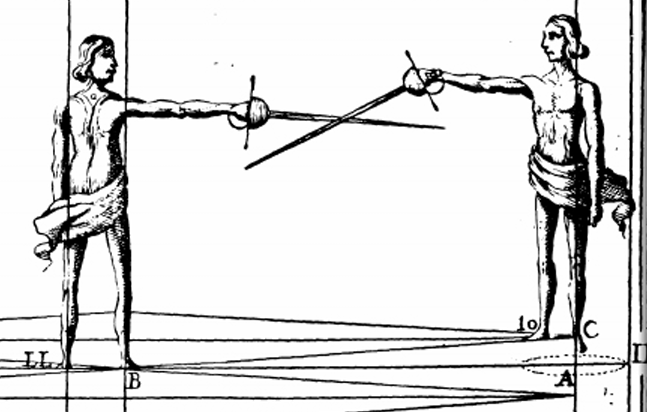
The default stance is the right angle. You will stand straight with your right foot (assuming you are right-handed) facing forwards and the left foot facing to your inside at around 90 degrees to the left. The heels are together. Now move your left foot back 6-9 inches, slightly bend your knees and bear your weight evenly on both feet. Your shoulder should be half-profiled with the right shoulder forwards. Do not over-profile yourself, but do not square your shoulders, either. You should be comfortable. If you over profile, then your sword arm will be weak and strained.
Now, hold your right arm straight out so your hand is at shoulder level, with a slight bend of the elbow. Hold your rapier with palm facing inwards (quillons perpendicular to the floor), in the Italian 3rd position. I think Italian 3rd is the most comfortable position, but you can also turn your wrist to have palm down or up, as needed.

The right angle represents your maximum reach. An opponent with the same length sword in the same position cannot hit your body or face without also being hit, and you will outreach them if they try to hit higher or lower.
Obtuse angle
Shorten your grip, lower your hand to around navel-level while keeping your arm straight, and raise the tip of your sword to head height. This is called the obtuse angle and is your primary defensive position, but can also attack (e.g. with cuts or high thrusts).

Acute angle
Hold your hilt high (shoulder height or higher), and drop your tip low. This is the acute angle and is used for certain defenses and attacks.
Attacks
There are 5 attacks in distreza:
The thrust, which is typically delivered using the right angle with a step (not a lunge). However, the thrust can be made from almost any angle, and these aren't differentiated.
The full cut from the right, made with a moulinet motion using priamrily the elbow.
The half cut from the right, made with just a motion of the wrist.
The full cut from the left (reverse), made with a moulinet motion.
The half cut from the left made with just the wrist.
Cuts typically come from above or horizontally, but rarely below.
Exercise 1: Practice the stances, and the attacks
By yourself, get into the right angle stance. Practice raising and lowing your sword. Now practice moving between the obtuse, right angle and acute angles. Get used to the weight of the sword and get comfortable with the grip. Now practice stepping forwards to thrust in the right angle. Now practice performing half cuts from left or right by raising the blade and cutting with the obtuse angle. Now try full cuts by dropping the tip and cutting around in a moulinet. Lastly, practice low thrusts by thrusting in the acute angle with a step forwards.
A summary of the system
Destreza is at its heart a defensive system. Fencers are not encouraged to attack straight on, but rather to use circular footwork to attack from offline. The goal is to get the opponent's blade off to the side. Attacks are often made diagonally. Defenses are also made by angling offline and pointing the sword over theirs rather than trying to maintain your point on target, creating a securer defence. It is better to defend while you seek an advantage rather than to attack prematurely. The core technique of the system is called an Atajo (pronounced A-ta-ho), which literally translates as a 'shortcut' but more accurately means 'constraint' or 'strong bind', and is similar to the gain/find/stringer in Italian fencing. Fencers use the Atajo to control the opponent's blade, and from here perform various techniques including cuts around, disengages, expulsions, and glides to cut or thrust at the opponent safely (a 'wounding action'), or to produce a disarm to force the opponent to surrender without harm - as killing the opponent is seen as the last resort.
In the next series of blog posts, I will try to lay out the basics of the system, as I come to understand it, so that something 'Destreza-like' can be learned quickly and effectively in a practical way.

Oh my god! I have been following your work for a quite a while now and I am absolutely thrilled. Right now especially, because you are writing about Destreza. Please don't see this as self-promotion, but feel free to check out my book on the subject: La Verdadera Destreza Volume 1: The Basic Course in the Spanish Art of Fencing in the 17th Century.