Practical Destreza (Spanish rapier) - Part 3: Atajos (gains), disengages and cutting over
The Atajo (shortcut, or bind/gain) is one of the core techniques of Destreza, similar to the gain/find/stringer in Italian rapier.
At its most basic is a bind of the opponent's sword, but it could also be a potential bind (a virtual Atajos). It is also your parry against both cuts and thrusts.
Defense
Actually, let's briefly start with how to defend against the opponent's attacks (thrust or cuts). It is commonly said that there are three ways to defend:
With the right angle - pointing the sword at the opponent which tells the opponent to 'get back!'. If they try to attack they will eat a thrust while doing so. If you are using a cup hilt rapier then you also basically have a small buckler on your hand, so this can defend you too.
With Atajo - more on this in a moment.
With movement - using your footwork to move away from the opponent's attack, and maintaining your distance.
The 8 Atajos
There are 8 Atajos, but don't worry, this isn't as complicated as it sounds.
The Atajo is simply a bind over or under the opponent's sword (using the Obtuse or Acute angle), done in such as way that the opponent cannot hit you directly but must move around your blade.
Atajo can be done on either side of the opponent's blade - the inside or the outside.
Lastly, when you are in the Atajos you can move left or you can move right (or away from or into their sword).
2 x 2 x 2 = 8 Atajos. There is an exercise that will get you doing all 4 of the Atajos done in the Obtuse angle in no time at all.
Rada numbers the Atajos. This isn't necessary to remember for now but we will refer to the Atajo numbers in later blog posts.
# | Angle | Position | Movement |
Atajo 1 | Obtuse | Inside | Left |
Atajo 2 | Obtuse | Outside | Left |
Atajo 3 | Obtuse | Inside | Right |
Atajo 4 | Obtuse | Outside | Right |
Atajo 5 | Acute | Outside | Left |
Atajo 6 | Acute | Inside | Left |
Atajo 7 | Acute | Outside | Right |
Atajo 8 | Acute | Inside | Right |
Obtuse Atajos
Your opponent is standing in the right angle. You are at middle distance, with your blade to their inside. Your move into the obtuse angle and fall on top of their blade with the true edge and orient yourself to your left, crossing their sword at about 45 degrees. The 3rd of your blade will be over the 2nd of theirs. You should initiate the movement to form the Atajo with your arm, and then you will take a slight step to the right within your personal circle, otherwise you will be too slow to form the bind if you lead with your feet. Importantly, your structure is in line with your blade and your body is behind your sword, in the 'shadow' of your blade.


Now that you have the Atajo, you can move circularly left or right, maintaining the bind on the opponent's sword, and they follow.


Now do the same but with the outside Atajos. It is exactly the same, except you start with your sword on the outside of theirs. As before, gain the Atajo with a movement of the arm followed by a slight pivot away from their sword, to bring your body behind your Obtuse angle. Now you can walk left or right, away from or into their sword.


Acute Atajos
The Acute Atajos are the same as the Obtuse Atajos, except that the sword on the bottom is the one constraining the one on the top. It is formed when the opponent is in the Acute angle, and allows for controlling the blade and thrusting the opponent beneath their hilt. It can also work as a sort of hanging guard. It can be done on the inside or the outside, and by walking into or away from the sword.

I don't want to dwell on the Acute Atajo at this stage, it needs some further exploration to discuss how and why it forms. However, it will be a simple enough exercise for two people to give it a go. At this stage, just note that it exists!
Atajo strength
The strength of the Atajo is based on three properties:
At what angle you are crossing their blade. Shallow angles are better for offence (e.g. making a thrust in opposition viable), larger angles are more secure. Broadly speaking, an Atajo that is 90 degrees is the strongest but least offensive. A 30-45 degree angle is 'ideal', and less than this is most offensive as the point is more online.
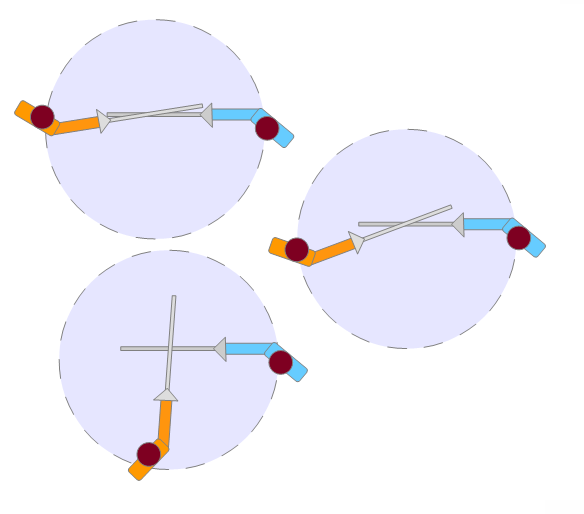
Whether you are stepping into their sword or away from their sword. Stepping away from their sword will make your Atajo weaker.
How much blade you have over theirs. E.g. Having your 3 over their 2 is ideal as that is natural at middle distance, but having your 4 over their 2 or 1 will be even stronger.
The Atajo as a parry
If your opponent thrusts at you while they are in the right angle, then you form an Atajo over their sword, pushing it away from your and/or stepping out of the way.
If your opponent cuts at you in the Obtuse angle then you can parry this in the Obtuse angle with an Atajo (see more below).
If your opponent thrusts underneath your blade in the Acute angle, then you can parry this with an Acute Atajo.
Why walk into or away from the Atajo?
If you are the one who has the Atajo, then walking along the circumference into or away from their sword has a purpose. It closes distance. It gets you offline. If walking into their sword, it gets your point online and can set you up for a thrust with opposition (a thrust while controlling their sword). If walking away from their Atajo it can set you up for an expulsion and a cut to their head, etc.
If you are the one subjected to an Atajo, then walking the circumference allows you to maintain middle distance, to prevent your opponent from getting closer to you or too far offline, etc. However, generally you won't want to stay being subjected to the Atajo and will try to free yourself of it using a disengage or cut.
Disengage under
This is fairly simple. If you are being subjected to an obtuse Atajo, then you can escape it by disengaging your blade underneath theirs. You then have the option to form an Atajo on their blade.
If someone disengages out of your Atajo, then you can form an Atajo onto the other side (e.g. if you were inside before, now you are outside), or you can perform your own counter-disengage to get back to your original side and reform the Atajo.
The best time to do the disengage is when they are forming the Atajo, or when it is quite weak.
Disengage over
When subjected to an Acute Atajo, you can't disengage under but you can disengage over, by lifting the point of your blade and placing it onto the other side of their sword. Here you can gain an Atajo of your own. Everything else said about the disengage under is true of the disengage over.
Cutting around
Instead of disengaging under their blade, you could perform a cut around (a full cut), especially if they have a strong Atajo on you as this will make a disengage under difficult. To perform this, drop the point and raise the hilt (essentially you go into the Aute angle) with palm up or down depending on the side of the blade you are on, and whip around the point to cut onto the other side of their sword, or at the opponent (but it is safer to cut to the sword).
Now, if the opponent does cut at you, you can defend against this by simply forming an Atajo on their blade. As noted above, the Atajo is also a parry against cuts and thrusts. Remember, get your body behind your Atajo.
Bringing it all together
That is a lot of information I've just dumped on you. Luckily, there is a simple exercise that will get you doing the 4 Obtuse Atajos very quickly.
Exercise 1: Walking the Atajos
a) Start at middle distance. Your training partner is in the right angle. Gain an Atajo on the inside of their blade. Both of you circle to the right, with you leading. Now you start circling left, and your training partners follows. The person with the Atajo leads by changing direction every now and then.
b) At some point your training partner, who is being subjected to an Atajo, will disengage under the blade to the other side. You will then gain an Atajo onto their blade on the outside. Again, you circle left away from their sword and they follow. Now you switch direction and walk into their sword, and they follow by doing the same.
c) When you are both comfortable with this, your partner will disengage under the blade when they want to, and you will gain the Atajo to the other side. Continue to mix the directions that you walk, into or away from their sword, as they disengage at random intervals.
d) Now your partner (who is still being subjected to the Atajo) will cut around your sword, instead of disengaging under it. You need to parry this with the Atajo, and regain the Atajo on their sword. Do this from both sides.
e) Now your partner will mix it up, sometimes disengaging, sometimes cutting around.
f) Obviously, both you and your partner will need to practice the above exercises from both perspectives.
Exercise 2: Make it a competition
Now you are both practiced on having and being subjected to an Atajo, you will make it a competition. If you are being subjected to the Atajo, you will try to disengage or cut around and gain the Atajo on them. They will try to regain the Atajo on you. Remember, you are not trying to hit your partner with a cut or a thrust, you are 'wrestling' for control.
When doing all of the above exercises, remember that you also trying to maintain middle distance.
A final word
This isn't the final word on the Atajo, as we will be exploring it more in future posts. However, I want to make something clear. The Atajo is how you defend yourself from your opponent. As you approach middle distance, what is to stop your opponent just making a suicidal thrust straight forward at you? What is to stop your opponent stepping offline and thrusting at you? Or trying to do any number of things to you? And if you try to do the same things to them, how do you stop them simply turning their blade to meet you? You have three tools: the right angle (get back!), the Atajo, and your footwork. You use the Atajo to control the opponent, to prevent them from attacking you, to allow you to safely move within the circle, and to set up opportunities for you to take advantage of their mistakes to safely hit them.
A final, final word!
One of the things about the Atajo is that it is very defensive. You get your blade properly crossing theirs, and your point is not online (at least without further effort needed). Compare this to more modern parries in smallsword or foil, where the parry is made with the point angled to be online or very nearly. (That is a simplification because there are smallsword systems that do not do this, but it is common.) This makes the parry less secure, but makes it harder for the opponent to simply feint or rush your position while you are parrying, and the riposte is quicker. The downside is that it makes it quite trivial for the attacker to shift their hilt up your blade towards your point in order to gain your blade. With the Atajo, particularly the ideal or defensive version, it is not really possible for the opponent to shift their hilt up your blade because their blade is underneath yours, and your blade is actively funneling their blade (with the help of gravity) away from your point and towards your hilt. I think it is worth noting this, because some will question the correctness of the Atajo. However, it is in line with contemporary uses of the 'gain' or stringer and parries in general, as found in contemporary Italian and German rapier treatises, such as Johann Daniel L'Ange.

Comments