Practical Destreza (Spanish rapier) - Part 2: Footwork and distance management
Basic footwork
Footwork in Destreza is fairly intuitive. There are:
Advancing steps: fight foot goes forwards, left foot follows.
Retreating steps: left goes backwards, right foot follows.
Traversing steps: if going right, the right foot moves to the right and the left foot follows. If going to the left, either foot can go left and the other foot follows.
Compass steps: like traversing steps but you pivot on your right foot a little to face the opponent.
Diagonal steps forwards or backwards: if going forwards, the right foot typically goes first, if going backwards, the left foot typically goes first.
Compass steps: like traversing steps but you pivot on your right foot to face the opponent.
Passing steps: crossing the feet, and is basically like normal walking.
Normal walking is great for circling the opponent. Single steps are great for sudden changes in direction. For anyone with fencing experience, this may come quite naturally.
Exercise 1: Practice stepping
Practice stepping in the 8 cardinal directions. Start slowly, and speed it up so that you can step in any direction fairly easily. It should be intuitive.
The three circles
Destreza prides itself on geometric proof that the system works. Rather than the linear footwork of the Italians, Destreza happens within an imaginary circle - well, three circles - and these circles naturally arise from:
a pair of opponents who have similar reach
a pair of opponents who can move around each other freely (e.g. they aren't bound by a linear strip or hallway), and
the need to maintain distance from each other for defence.
Take your rapier and, in the right angle, turn yourself around in a circle. You have just traced a circumference. Add a few feet to the diameter of that circle to account for the fact that you can step forwards to attack, and you have just described your maximum circle, which is the distance you can reach with a single step forwards.
Your personal circle is the circle that you just pivoted your feet around to trace out your maximum circle. The personal circle isn't really important so we can largely ignore this.
Your opponent also has a maximum circle, and when your opponent stands at the edge of your maximum circle, if both fencers were to maintain their distance and walk around each other, this would trace the circumference of the common or shared circle. See figure 1.

The maximum circle represents the circumference that your opponent must maintain if they are to walk around you while trying to maintain middle distance (see below), if you are remaining stationary.
The shared circle is the circumference that both fencers are to walk if they are walking around each other while maintaining middle distance.
In order to attack, one fencer must enter the maximum circle of the other fencer, placing themselves in danger because their opponent is also now within their maximum circle.
This might sound confusing, but we will see what this all means from a practical perspective below.
Middle distance
The medio de Proporción, which I will call middle distance, or average distance, is simply the distance at which you can attack your opponent with a step forwards. Assuming both fencers have swords and arms of equal length, this is usually considered to be the distance where the tip of your opponent's rapier is just in front or just behind (depending on who you ask) of your cross guard. If your opponent has a longer weapon than you, then your point may be a few inches away from their cross guard. You always want to make sure your opponent must take a step forward to attack you, otherwise you are too close to defend against them. Do not allow them to get closer.

Exercise 2: Find middle distance
Both fencers stand at middle distance in the right angle and practice a thrust at each other, one at a time, with a single step forward. If they are too close or two far away, then adjust and try again. Learn to recognise where middle distance is and where the point of the opponent's weapon is relative to your hilt, and vice versa. Be careful and wear the right fencing protection (masks, jackets etc.).
Circling a stationary opponent
Here one fencer is circling a stationary opponent. The opponent turns on the spot (or about their personal circle) to face the other fencer, maintaining middle distance. Compass steps or passing footwork can be used. The fencer can circle the opponent in either direction, left or right. Notice how the fencer who is moving walks along the circumference of the maximum circle, not the shared circle.

Exercise 3: Circle a stationary opponent
Your training partner stands stationary in the right angle. You will walk around them, also in the right angle, maintaining middle distance as they turn to face you. Using different types of footwork, either walking steps or single steps. Change direction. Speed up, slow down, etc. If you want to make it harder for you, one of you can step backward or forwards, or to the side, and the other must maintain distance.
Circling each other
Both fencers now walk, or take single compass steps, about each other. They can go in either direction, and can switch direction at whim, one fencer often leading the other like a dance. Because they circle each other they follow the circumference of the shared circle. Their individual maximum circles move with them - but in many of the following images I do not move the maximum circles with the fencers to better show their movement within space.
Remember: the circles only exist within the minds of the fencers. They are not drawn on the ground (unless a teacher draws them for training purposes). It is easier for the fencer to imagine the circles to be in place at the beginning of an exchange, within which they will move, and then the circles reset when the fencers return to middle distance.

Exercise 4: Circle each other
You both stand in the right angle at middle distance, and you begin circling each other. One of you leads, the other follows. The leader changes direction every now and then and the other follows. To make it harder, the leader changes direction more often, slows down, speeds up, sometimes making quick changes of direction to catch the partner out. The leader steps diagonally forwards or backwards, and the other tries to maintain middle distance by also stepping backwards or forwards.
Moving within the circles
Unless you have control of your opponent's weapon so that their weapon is no longer pointing at you, you do not attack or gain distance on your opponent by stepping straight forwards. Instead, you step sideways, using passing steps, traversing, compass or diagonal steps.
For illustration, imagine both fencers are circling each other, and one fencer stops circling and remains stationary, but the other fencer continues. From one perspective the fencer who continues is walking on the circumference of the shared circle, but from another they are starting to spiral inwards within the maximum circle of the opponent, like a satellite spiraling out of orbit for a crash landing back to Earth.
This means that, by walking the shared circle even though the opponent has stopped, they are now getting closer to the stationary opponent. From Figure 5 we can see that a single compass step against a stationary opponent along the circumference of the shared circle has moved orange fencer closer than middle distance, but not close enough to hit without taking another step.

In figure 6, blue fencer has taken a compass step to return to middle distance.

In figure 7 it is shown that, if blue fencer were to remain stationary, orange fencer would be able to hit with 2 or 3 compass steps along the circumference of the shared circle, skewering blue fencer between steps 2 and 3.

In figure 8 it is shown that orange fencer does not need to keep to the circumference of the shared circle, but can step diagonally within it. However, since the step is a finite distance, lets say 3-4 feet in size, whereas the step straight forwards would result in a successful thrust against blue fencer, the diagonal step falls short because it is made at an angle.

In figure 9, it is shown that the solution is to add an additional preparatory step made with the left foot crossing behind the right foot onto the circumference of the shared circle (so that the left foot is now even with the right foot). A diagonal step forwards will now result in a thrust reaching.

Figure 10 shows that, following the successful thrust, orange can take another diagonal step backwards, and will end up back at middle distance, on the circumference of blue fencer's maximum circle.

Before the thrust lands, however, figure 11 shows that blue fencer can take a step or two away from orange fencer, to the side or even straight backwards, to maintain the distance.
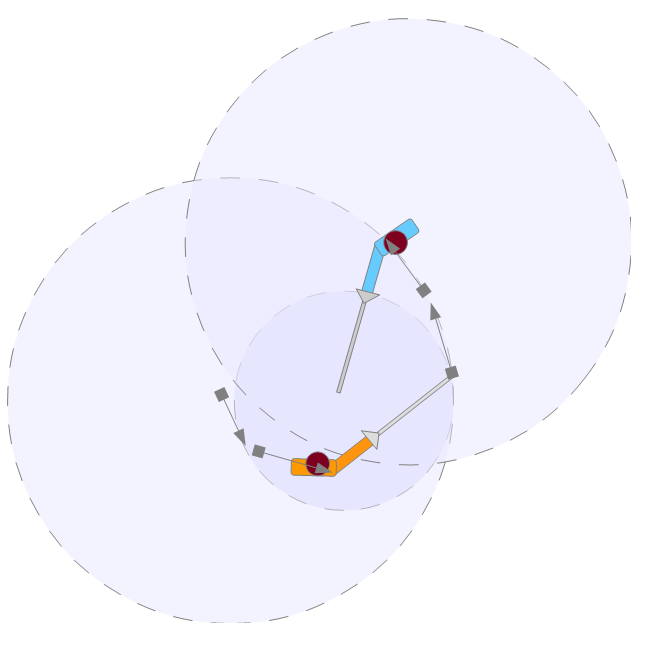
The circles then reset to the new positions of the fencers, as in figure 12.

Exercise 5: Gaining distance
Similar to exercise 4, the training partners are circling each other. One fencer tries to gain distance on the other by making changes in direction. Can you get close enough, without take a step forwards, to land a thrust? This can be done when circling in either direction. Be careful not to hurt your training partner with your thrust. Practice slowly at first.
Exercise 6: Diagonal step
Both fencers are stationary at middle distance. One fencer takes a diagonal step forwards. Can they land a thrust with a single step? Now have them take a preparatory step with the left foot. Will the diagonal step now land the thrust? Regardless of whether the thrust lands, they should now take another diagonal step to get back to middle distance. To make it harder, have the opponents circling each other, and have one fencer try to attack with the diagonal step and then move back out to the distance. Alternatively, have one fencer stationary and the other moving along the maximum circumference, and then attacking and retreating diagonally (remembering the preparatory step). Be careful not to hurt your training partner with your thrust. Practice slowly at first.


Comments